|
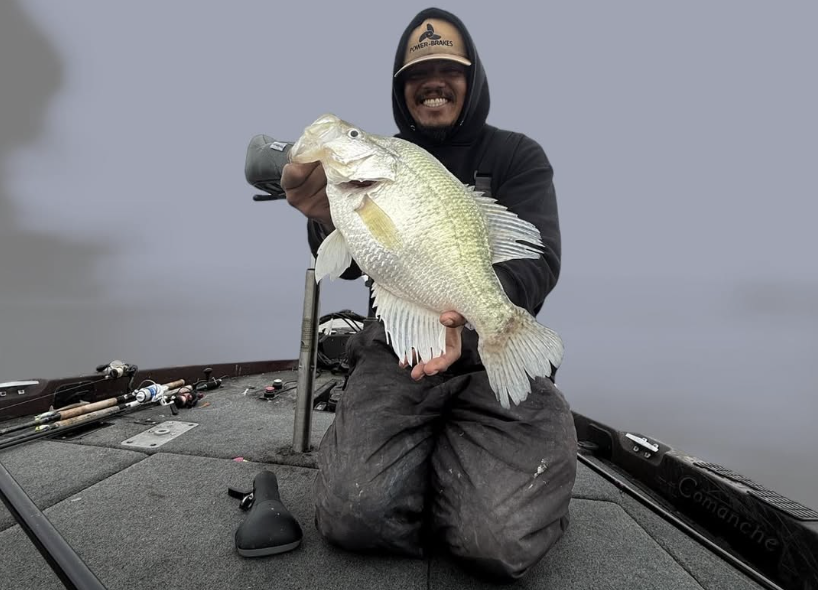
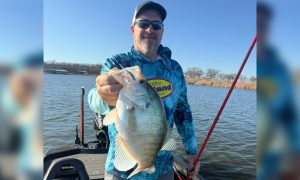
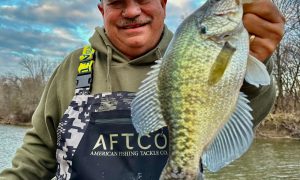
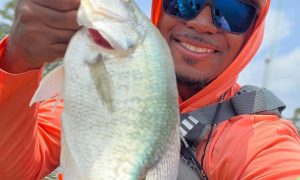
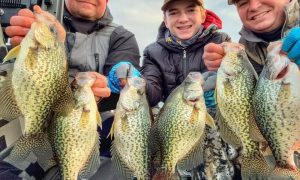
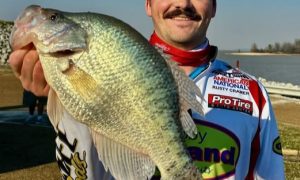
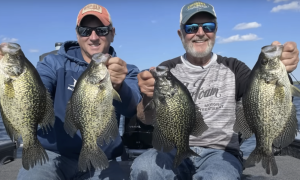
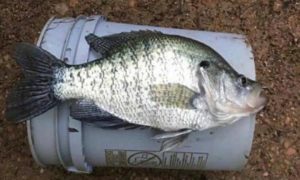
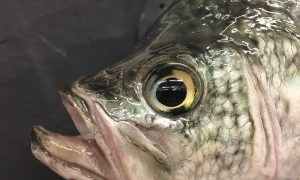
Hey y'all! Finally got cold down here in TX, and the crappie are starting to do their winter thing so that's exciting! Been fishing for bass but I can't get away from the slabs! 😁
|
|
|
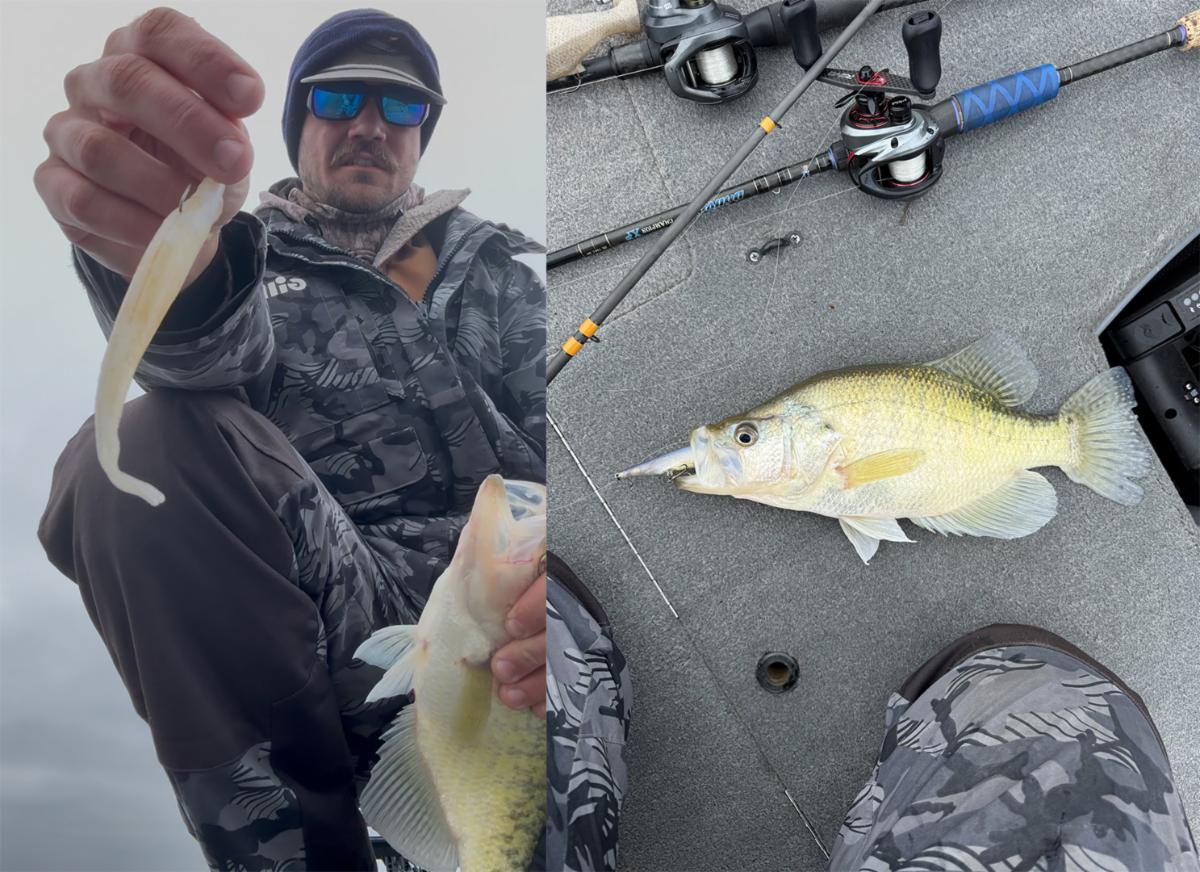
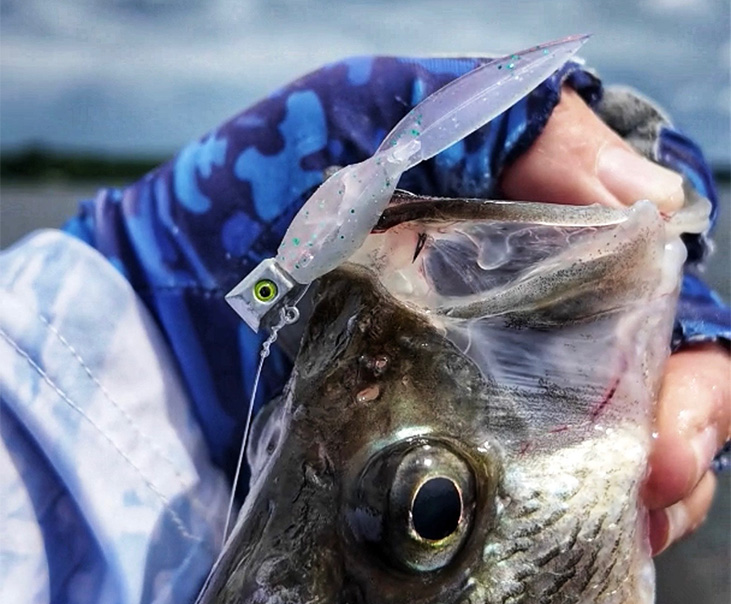
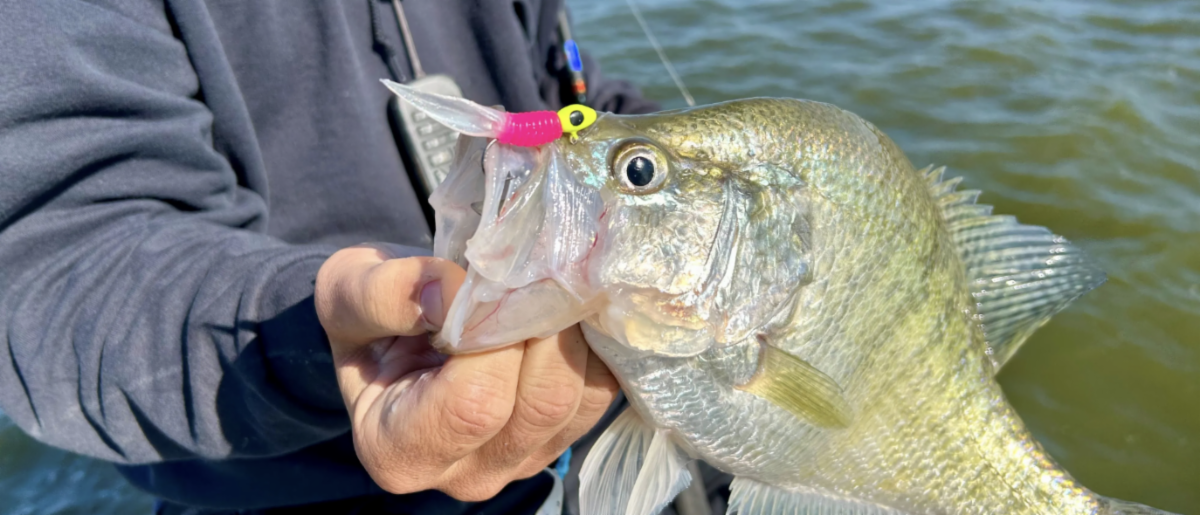
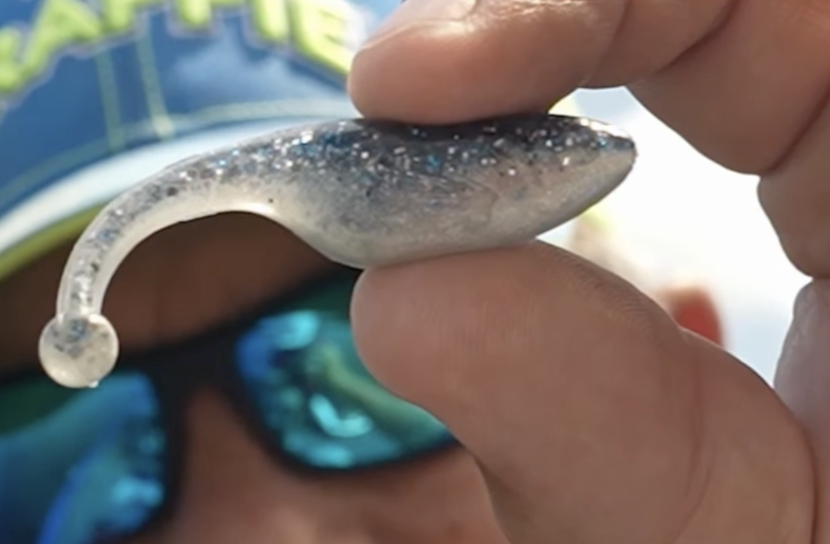
That bait on the left is a 6" – yes 6"! – Z-Man Scented Jerkshadz, and the bait on the right is a full-size jerkbait. Those crappie were acting nuts the other day and I'm all for it! 🤠
If a buddy shared this with you, make sure you sign up here to get the free weekly email straight to your inbox – hope you enjoy this one!
|
|
|
If your email program cuts off the bottom of the email click "View this email in your browser" up top to see the whole thing. Sorry about that – email programs keep changing stuff!
|
|
|
|
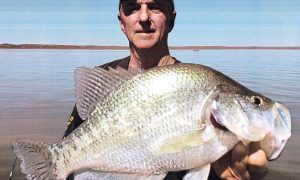
Got back with TX guide Tommy "I catch big fish on a cane pole" Ezell to pick his brain about chasing big, trophy crappie.
Tommy went all in on the big fish deal about 14 years ago and does seminars nationwide about it, teaching folks how to target those giants. No matter where yer at, here's some big fish juice you can use this winter to go catch that PB while the feed bag is on!
1. What specific things does someone have to do to set himself up to catch a huge crappie?
> "First and foremost, people have to understand that once crappie are big enough that they're not on the food chain, those crappie tend to live alone.
> "...when you're sitting there on a group of fish hoping that you catch a big one out of that group, what you're actually doing is you're wasting time.
> "If you'd have got away from those smaller fish and gone and fished some more-secluded areas with just 1 or 2 dots using your electronics, those are going to be your big fish."
2. How do you target those single big fish?
> "I would tell them to go to the areas where there are a lot of crappie, but look for those singles. Do not sit there on those big schools. Go look for those singles."
Follow-up: Do those bigger fish relate to anything?
> "Understanding each seasonal pattern is going to help you.
> "Right now those fish are moving down those main-lake creeks or river channels if you do have them. If you don't have them, go to another lake, period.
> "...another little secret is when you're going down that river channel, what I've found is that those bigger fish like the outside edges of cover.
> "If you have a patch of timber and you have a quarter-mile pasture til the next patch of timber...[skip the pasture] and go to the edge of that timber."
3. What gear do you need for big fish?
> "No matter what, even if they're deep this time of year, you still want to use a longer rod – the shortest rod is going to be a 13-footer.
> "If you're chasing them, you might want to go up to a 16-footer.
> "A longer rod is [needed] because we don't know how smart those fish are. They're very instinctive. Once they've gotten big, they know what a boat is, they know what trolling motor noise is. They know that's danger.
> "The further back you can stay away from them, the better.
> "For line, I've always used braid because I fish a lot of lot of big trees. I use 12-15 lb braid and a 12-15 lb fluorocarbon leader.
> "And this time of year, you're definitely going to want a weight bagged above your jig – usually about a 1/4-oz for me.
> "For rods, I am in love with two rods: The Big TX X13 by Jenko – a 13' rod.
> "...also a rod by 3Pound Fishing, the 'Savage'. It's a 13' rod, but it has has inserts...where you can change that rod to a 14 or a 16. I primarily run that rod [at] 16' if I run around chasing fish or get near some spooky fish.
> "For my bait, depending on what they're eating I'm running...a 1/16 [Thermocline Lures] Hex Wedge Jig Head. We designed the Hex Wedge to where it has flat surfaces and will sparkle on FFS deep in a tree....
> "...and I'm using the 2-inch [Thermocline Lures] Tadpole the most – right now they're eating some bigger baits."
|
|
|
4. How important is the right rod action?
> "It depends on what your goals are and where you're fishing. For me [it's] non-parabolic, very strong, lots of backbone with a fast tip so I can feel everything.
> "Some of those northern states and even over East – AL and GA – they like 'em more parabolic. Their fish just aren't as big.
> "The problem is, I can't fish a parabolic rod [because] I'm never going to get those big fish out of a tree.
> "For presenting a bait, I've never been able to fish with parabolic rods. If you don't have control of that jig, and if that jig is bouncing around you're less likely to get bit.
> "We fished Millwood [AR], last week and that [action] was one of the problems. We were fishing with canepoles, and it was hard to keep that jig still.
> "They wanted it sitting still on their nose for literally about a minute before they would react and move. When those fish are lethargic, you really want to keep that jig still."
5. Do you think people look too deep in the winter for big fish?
> "History won't tell you where to go in a lake anymore. Yesterday I fished the deep for about 5 hours because that's what we're taught.
> "My biggest fish yesterday was in 12'...the lake had 30' of water in it.
> "I had everything but a 3-lber. I thought to just go up to the shallow end [even though] they're not 'supposed to' be there. Well those fish were there.
> "There's not going to be a bunch of fish there, but I caught a 3-11...I saw some really big fish. They're harder to catch because they're shallower, but you have to challenge yourself if you want to catch those big fish."
|
|
|
"If you find blue cats there's a good chance there's a lot of crappie stacked up underneath 'em."
|
|
|
Say what? 😳 That's Bobby Garland's Skylar St. Yves talkin' winter slabs sitting under dying baitfish! Let's get into it!
What's a deal in the winter people often overlook?
> "As we get a little bit farther into the winter...shad start dying off at a certain threshold. [Crappie] are looking for a bigger profile [bait], but the swimming action...we're starting to get away from.
> "We're starting to get water temps now where [white crappie] want a big meal, but they don't want to work very hard.
> "I'm starting to get reports from bass fishermen who...using 3-3.5 maybe even 4-5 inch baits are targeting bass and catching big crappie.
> "You still need the big profile, but you've really got to slow it down [and] get it to where it's either a dying imitation or very slow-moving."
|
|
|
What crappie presentations get that weak/dying shad imitation?
> "The 2.25-inch [Bobby Garland] Slab Hunt'R, the 3-inch Slab Slay'R, and the 2.25-inch Minnow Mind'R are our 3 baits that kind of take up all of our winter techniques. [Those baits listed are L-R in the pic.]
> "The Minnow Mind'R is a great dock-shooting bait. It can be used vertically as well. It's nice, slender, ribbed body with that longer presentation.
> "Still has the cup-style tail that the Slab Slay'R has, but it's a split tail. When you're shooting it, it gives you a little bit more gliding action and a little bit more fluttering....
> "It's one that you can really slow-roll and pop it occasionally...good, subtle features and action, but it's long enough to imitate most of that wintertime forage.
> "But for the open water big white fish, it's going to be the 3-inch Slab Slay'R, and the 2.25-inch Slab Hunt'R.
> "[For color], no matter what the water clarity – focus on bright colors, but especially pale white. White or a pearl white, a bone white, white/ chartreuse.
> "If you find blue cats, there's a good chance that there's a lot of crappie stacked up underneath them. Blue cats...know that the shad are in dire straits come winter, and they herd them like orcas.
> "Grand Lake is a great example of a lake where you have thousands of blue cats ranging in size chasing shad all over the place. Crappie...are waiting for the scraps underneath.
|
|
|
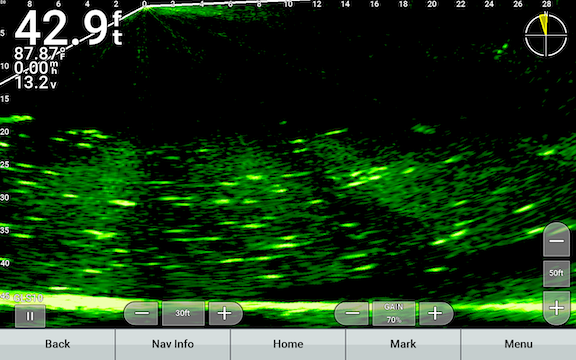
[For reference, here's a big school of catfish on LiveScope from Outdoor Hub.]
> "...when you're in the mix and there's tons of bait everywhere...there's so much natural, dying bait in the water, that's when a brighter color will help your bait stand out.
> "...an orange, a chartreuse, maybe even a junebug, pearl, chartreuse, something like that. That's really going to stand out."
When is the trigger for a dying bait imitator to get good?
> "It's going to be different everywhere. Most of the time it's going to follow really big cold fronts.
> "Up north...predominantly black [crappie] – those fish are acclimated to ice. Gizzard shad have a little bit higher tolerance [to cold]. They may have an entirely different deal....
> "MO, southern IL, southern IN or TN, KY, southern OH – places that may see some ice-over during the winter but aren't a hard ice region – you're probably going to start to see it as early as Nov.
> "When your water temps are cruising below 60 quickly, you're coming across that big-bait feeding pattern.
> "Once you get into OK, to the Gulf states and over to mid-Atlantic states, you're looking at Dec.
> "This is the beginning of it. It'll stay prevalent for the next 2-3 months.
> "No matter where you fish, especially if you're targeting white crappie, you can start throwing that bigger-profile bait, starting in probably about Oct."
|
|
Small details key for catching hardwater trophies in fishbowl lakes
|
|
|
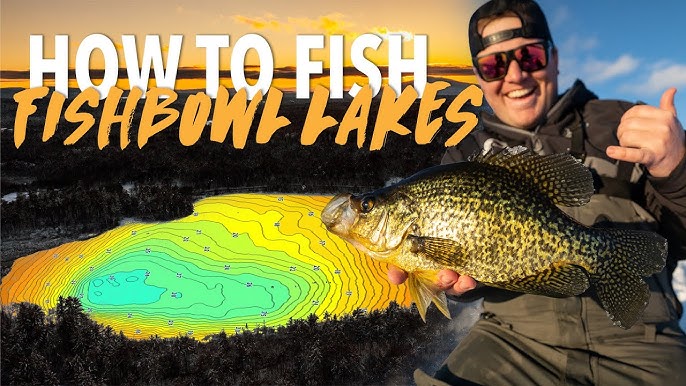
Adam 'Bart' Bartusek and the Crappie Chronicles crew are in the know about how to target GIANT northern crappie in the winter.
They just posted this great video with really good insights on how to target the biggest crappie lurking in northern fishbowl lakes. Quick 3 juicy tips from it:
1. Stick to confidence baits and cover water
> "The biggest thing with these lakes – fish with your confidence...you really want to keep things simple.
> "Usually...we'll hop out with very minimal tackle and we will start covering water.
> "The biggest thing with these lakes, you hear it a lot – drill a lot of holes. That is [key] because they can actually be anywhere. [Crappie] have nowhere they really [have] to be – they just kinda wander around."
2. Strategically pick your starting spot and go from there
> "When [fishbowl lakes] first freeze up, if there was any big winds the week or 2 prior...what that can usually do is push fish onto 1 side of the lake.
> "It's a bowl – there's no real good structure that you can visibly pick out that those fish are going to be holding to. [So] wind-driven current, that's usually an area that we're going to try to start on.
> "In this type of lake, everything is something – so always make sure you key in on the little things.
> "Pick your favorite depth range, spread out if you have a couple of guys, break [the lake] down.
> "We lean on OnX Fish a lot. If there's any information on there about area insights or something like that, that could be a helpful place to start.
> "You can look at the lake map, maybe find some sort of depth contour, something that looks attractive. But at the end of the day, you're just going to get out there and start going to work."
3. Pay attention to small contour changes
> "Slight areas of [contour ]difference are huge with fishbowl lakes.
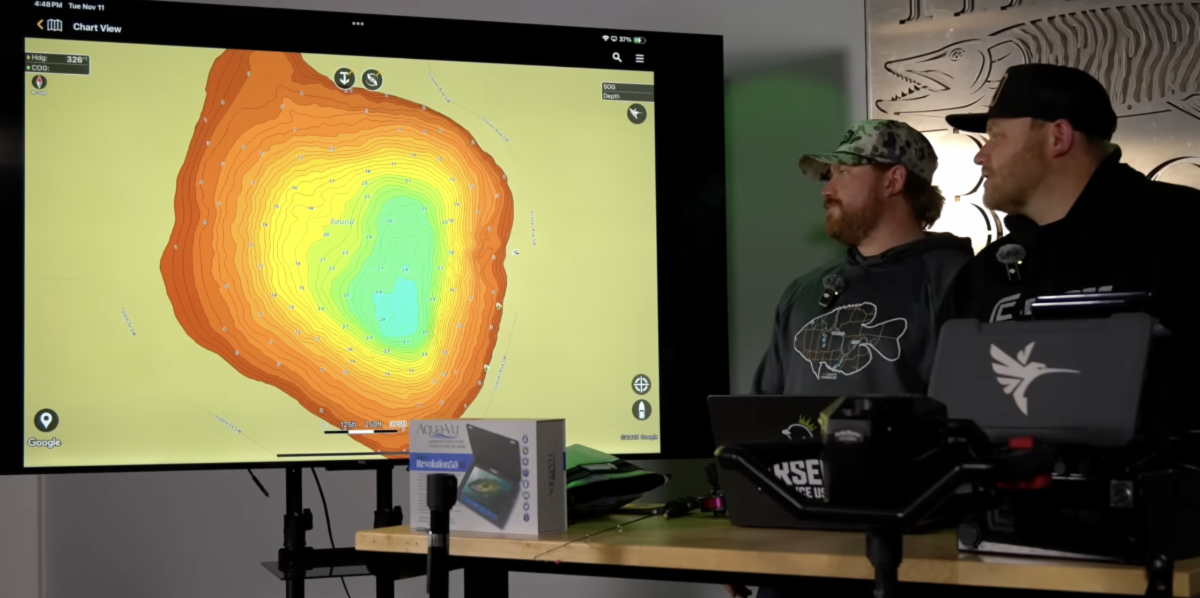
> We have our [Humminbird] One-Boat Network app up [which] actually has very good contours on this fishbowl lake.
|
|
|
> "Going around the entire perimeter...you have very tightly-packed contours or depth changes. It's very even, but you've got technically 3 big areas of difference here.
> "The big one that sticks out to me the most is this area right on the west side of the lake. You will see that there is an area where [contours] are spaced [differently], where everything else is uniform.
> "This small area of difference is almost like a feeding shelf. That's something that the fish can push up on.
> "The other big one [is] a little bit of a lobe where the basin's wider...but it becomes more concentrated. This is also another little shelf-type area.
> "There's not necessarily a big point or a giant inside turn that sticks out. They're just little flats that fish could utilize. Small details like that can make a huge difference."
|
|
Check out this Humminbird MEGA Live 2 vid!👀
|
|
|
Just a quick glimpse of a cool video from MO fishing pro Terry Blankenship when he was doing a little slab-catching with his Humminbird MEGA Live 2.
Terry is slip-bobbering a pile, and you can as clear as day see that big crappie come up and smoke his jig!
What's he slip-bobbering with? Well:
> The latest software update has improved my detail, and Bobby Garland‘s Baby Shad with a Blankenship Coil Spring Locking Jighead did the job.
And yeah, it sure does look like the new MEGA Live 2 improved his detail! 😃
|
|
Crappie listen with their bones? 😳
|
|
|
If this isn't some motivation to quit slamming that compartment lid, then I don't know what is! 🤣 Check out this crazy interesting info from B'n'M Poles about how crappie are "way more aware than most anglers realize:"
> Crappie have a set of tiny bones called the Weberian ossicles that link their swim bladder directly to their inner ear.
> When sound waves hit the water, the swim bladder vibrates like a little drum. Those bones then carry the vibrations straight to the ear, acting like a built-in amplifier.
> The result? Crappie can detect extremely subtle noises: a dropped jig box, a thump on the boat floor, even quiet shifts in water pressure when predators or baitfish move nearby.
> So while we’re watching our bobbers...they’re listening to everything.
I did some digging, and sure enough, it is a set of 4 little bones that connect the swim bladder to the inner ear.
So when vibrations hit the swim bladder, the vibration from those waves goes directly from the swim bladder to the ear – which gives crappie crazy good "hearing."
My 2 biggest takeaways:
1. If crappie are having trouble finding your bait, or you’re trying to really get their attention or make them mad, small, subtle, constant vibrations with your rod tip should be key.
2. If you have a fishing buddy who likes to talk the whole day, now you have scientific evidence to back up your request for them to keep it down! 😅 Haha just messin’…kinda. 🤨
Also, for whatever reason when one of our guys (Jay) heard those words "Weberian ossicles" he thought of this:
|
|
|
It's big-bait season! Mr. Crappie has the Slabalicious and the Shadpole now in the XL 2.5" size and 14 new colors, some of which are pretty unique to crappie fishing.
|
|
|
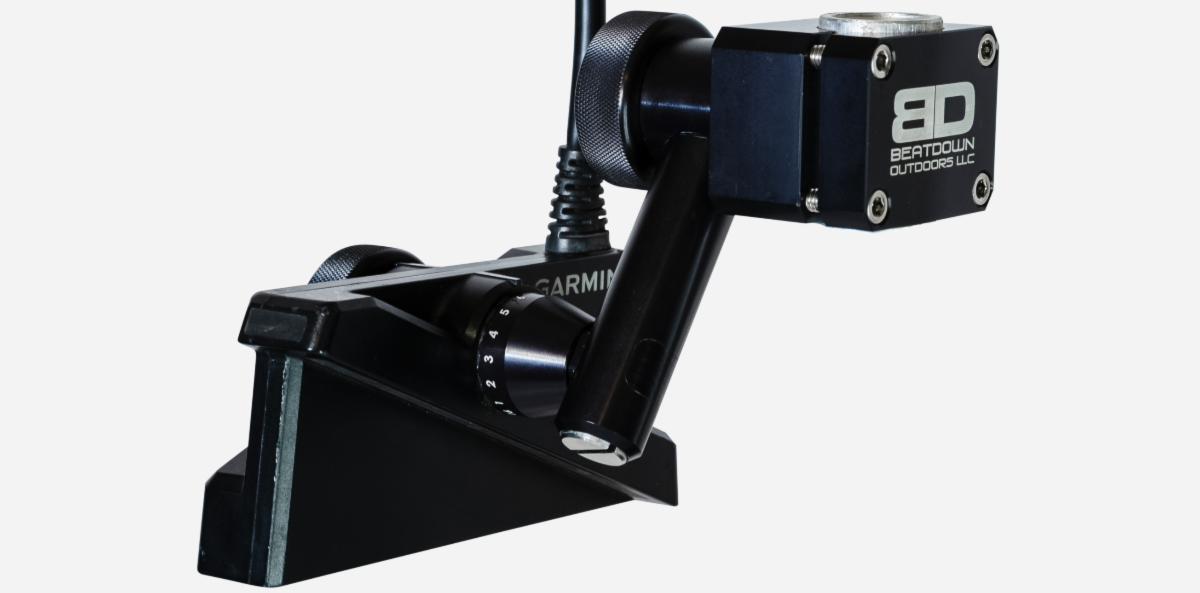
The way this deal mounts on your trolling motor puts the transducer directly in line with your trolling motor head – no more casting to the side. The beam is always straight ahead.
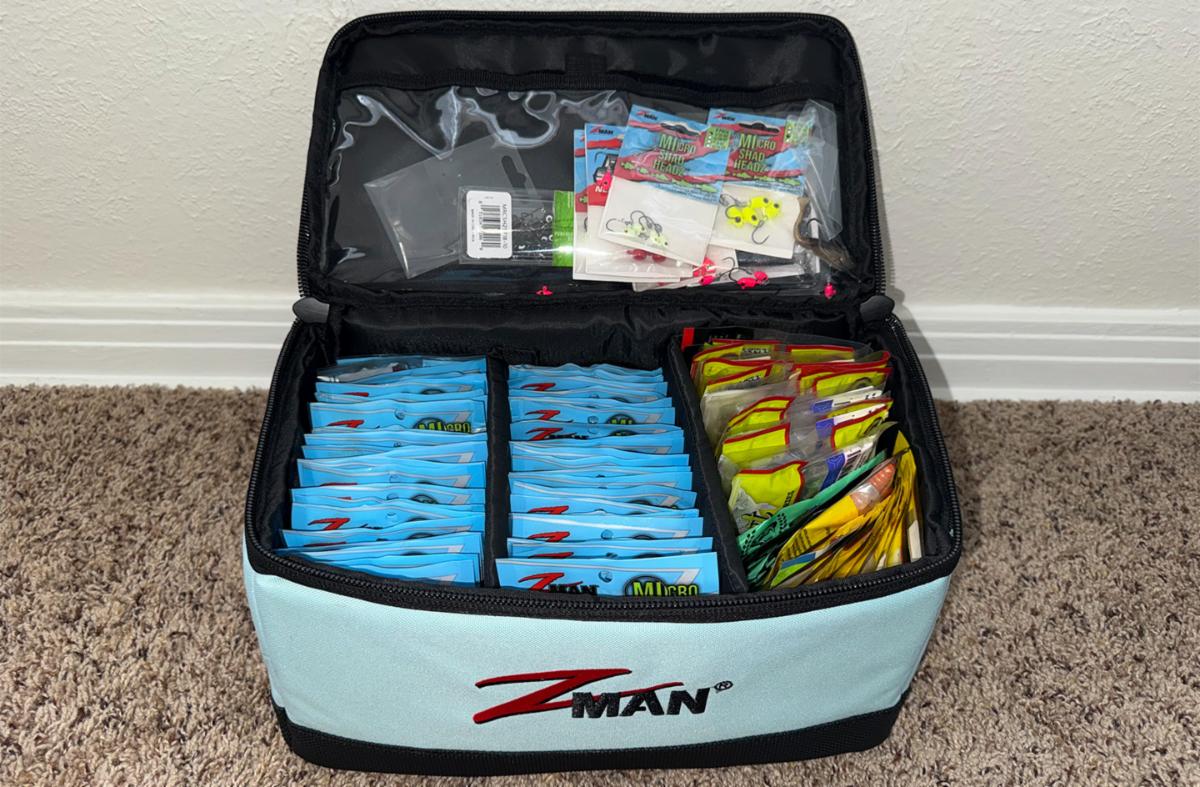
11. Check out Z-Man's Holiday guide
|
|
|
Use split-tail baits because...
> "99.9% of a crappie's diet is a split-tail fish."
That's OK hammer and co-host of Crappie Connection's Today's Bite podcast, Dustin McDaniels, talkin'. More:
> "You got a split tail on the threadfin shad, gizzard shad – everything they're chasing has a split tail on it.
> "So a [Bobby Garland] Live Roam'R mimics the exact tail that they're chasing almost all their life. That's where it's important to me.
> "Straight-tail baits still work great, but if you want that extra [deal] just in your mind... it's something natural – a split-tail is the way I'm going."
|
|
|
"...shaking a rod tip, tapping a rod tip, touching your line, holding it with another hand, giving it a little bit of a twitch, but very subtle motions."
- That's Skylar from Bobby Garland talkin' about making those super-subtle movements with your rod/line because:
> "...as the water temps get low, you want that bait doing all the work...barely moving.... You are trying to create vibration that those crappie are sensing, but they don't want it to move around. They want to come up and...just inhale it."
|
|
|
Sign up another crappie-head!
If you're forwarding Target Crappie to a friend who loves to crappie fish or want your fishing buddies to get these emails, just send us their email addresses and we'll take care of it! (We won't sell the addresses, use them for spam, etc.)
|
|
|
FRIENDS OF TARGET CRAPPIE
|
|
|
|